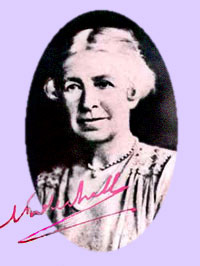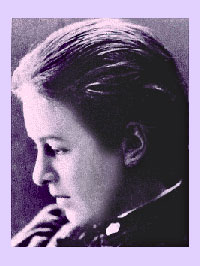
Who Is Evelyn Underhill (1875-1941)?


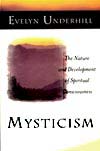
"Evelyn Underhill was born in Wolverhampton in 1875, and educated at King's College for Women in London. English poet, novelist, and writer on mysticism, she is widely regarded as one of the most distinguished writers on mysticism. In 1921 she was Upton Lecturer on the Philosophy of Religion at Manchester College, Oxford, and the first woman to give a series of lectures on theology at Oxford. Her writing and lectures brought her an international reputation and a fellowship at Kings College for Women, but her lasting fame rests on the many books she produced on various aspects of mysticism. She published her first book in 1902, but her growing interest in mysticism ... [in her youth she was a member of The Golden Dawn]... led to her greatest work, the most famous, Mysticism,a comprehensive study of the spiritual life and religious experience which remains a classic. It was first published in 1911."
She wrote in 1930, "since this book first appeared, nineteen years ago, the study of mysticism—not only in England, but also in France, Germany and Italy—has been almost completely transformed. From being regarded, whether critically or favourably, as a byway of religion, it is now more and more generally accepted by theologians, philosophers and psychologists, as representing in its intensive form the essential religious experience of man.
The labours of a generation of religious psychologists—following, and to some extent superseding the pioneer work of William James—have already done much to disentangle its substance from the psycho-physical accidents which often accompany mystical apprehension. Whilst we are less eager than our predecessors to dismiss all accounts of abnormal experience as the fruit of superstition or disease, no responsible student now identifies the mystic and the ecstatic; or looks upon visionary and other "extraordinary phenomena" as either guaranteeing or discrediting the witness of the mystical saints." (From the preface, 12th edition.)
Among her other fine works are: The Mystic Way (1913), "Practical Mysticism" (1915), "The Essentials of Mysticism" 1920), "The Life of the Spirit and the Life of Today" (1922), "Concerning the Inner Life" (1926), "Man and the Supernatural" (1927), and "The House of the Soul" (1929).The Essentials of Mysticism is a collection of some her most famous lectures. Evelyn Underhill's masterly accounts of Christian mysticism and devotion include Mysticism, The Mystic Way, Practical Mysticism, Concerning the Inner Life and The Spiritual Life. (Quoted from the ""The Essentials of Mysticism and Other Essays"")"A little more: Quoted From ""Daily Readings with a Modern Mystic: Selections from the Writings of Evelyn Underhill"," Delroy Oberg, editor
It often happens that well-known writers suffer a period of eclipse after their death. This has certainly been the case with Evelyn Underhill. During her lifetime, and in particular from the publication of her major work Mysticism in 1911until her death in 1941, Evelyn Underhill was one of the best-known spiritual writers in Great Britain. However, after her death her reputation declined.
In the 1950s and 1960s she was criticized for making the spiritual life too comfortable and private, and for not being sufficiently in touch with the social and political realities of her time. How far these criticisms were justified, readers of this selection from her works will be able to judge for themselves. Such criticisms seem to me to be for the most part superficial and misdirected.
What is beyond question is that in the last ten years and more interest in Evelyn Underhill's life and work has been growing rapidly, first in the United States and more recently in Britain. It is not too difficult to see why this should be. Evelyn Underhill was a pioneer in the twentieth-century study of mysticism and spirituality. She was a prolific writer who produced many books, some large and academic, others small and easily accessible, but all centered on this one theme. Now, for whatever reason, the last twenty years have seen a growing interest in mystical and spiritual questions throughout the English-speaking world and it has been natural for people to turn back to one of the outstanding exponents of these questions from the earlier part of the century. Evelyn Underhill was also a pioneer in that she was a woman exploring these fields of studies. She was working at a time when it was very unusual for a woman to become an authority on theological matters, to lecture at the University of Oxford, to speak in Canterbury Cathedral, to become well known as a retreat conductor and spiritual director. These accomplishments that would be normal today were not at all normal in the years between the two World Wars.
But into all these areas Evelyn Underhill made her way. Quietly and without fuss, she became the first woman to break into realms that for centuries had been exclusively male preserves. She did not indulge in polemic and controversy; she simply went ahead and opened the doors.
Evelyn Underhill was the daughter of a London barrister, and married in 1907 to a childhood friend who was also a lawyer. She and her husband were in many ways typical upper middle class people of their time. Inwardly, however, beneath the carefully "ordinary" exterior of her life, Evelyn was thing but ordinary. She was a woman of great intelligence, of remarkable energy, and of passionate commitments. For her, as for many of her contemporaries, it was not easy to live a deeply religious life in a world that either ignored religion altogether, or at least took its claims lightly. Her interest in the great mystical writers of the past was far from being simply academic; it was because she longed to live with the same immediacy of contact with the Divine that she gave so much time to studying and expounding their writings. She longed to make the teachings of the past come alive for her contemporaries and she succeeded in doing this to a remarkable degree.
One of the most remarkable qualities of her work, taken as a whole, is the variety of styles it encompasses, from scholarly editions of medieval writers, through essays for theological periodicals, to retreat addresses and meditations intended for lay people of all backgrounds. In her writing she constantly seeks to combine the analytical with the experiential, the academic with the imaginative in a way not at all common among theologians; this perhaps reflects a specifically feminine concern for the wholeness of human life and experience."
From the cover of the Image Book edition
"First published in 1911,Mysticism remains the classic in its field and was lauded by The Princeton Theological Review as "brilliantly written [and] illuminated with numerous well-chosen extracts . . . used with exquisite skill.""Mysticism makes an in-depth and comprehensive exploration of its subject. Part One examines "The Mystic Fact," explaining the relation of mysticism to vitalism, to psychology, to theology, to symbolism, and to magic. Part Two, "The Mystic Way," explores the awakening, purification, and illumination of the self; discusses voices and visions; and delves into manifestations from ecstasy and rapture to the dark night of the soul. Rounding out the book are a useful Appendix, an exhaustive Bibliography, and an Index. Mysticism is thoroughly documented with material drawn from such great mystics as St. Teresa of Avila, Meister Eckhart, and St. John of the Cross."--

For more bio inofrmation see: Evelyn Underhill's Quest for the Holy: A Lifetime Journey of Personal Transformation
or search Google


You May Buy this Book at
www.GnosticBooks.Com


Contents of Mysticism | Gnostic.Org