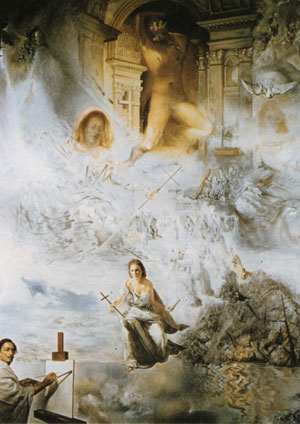
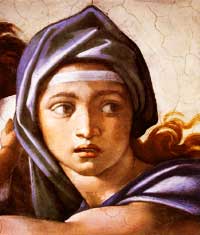
 In the present day, only a few Christian spiritual traditions allow the ordination of women and in most Orthodox traditions, the ordination of women is forbidden. Why? Most traditions claim that there is no history of women being ordained and thus there is no precedent. Should women be ordained? When in the past were women ordained? What roles have women played historically in religion? Were they leaders of men and should they be leaders of men? These are the real questions?
 Religious Tolerance.Org states in its findings:
The feminist movement has raised the public's consciousness about the unfairness of gender discrimination. Modern-day secular society has responded by eliminating sexism in employment, education, accommodation, etc. A large portion of the public has accepted that women should be given the same career opportunities that men have long enjoyed.
It is obvious that, early in the 21st century, the largest institutions in North America which will still deny equal rights to women are among conservative Christian denominations: Roman Catholicism, Eastern Orthodoxy and many denominations within Protestantism, like the Church of Jesus Christ of Latter-day Saints and the Southern Baptist Convention. These groups interpret Bible passages as requiring women and men to follow defined, sexually determined roles. In opposite-sex marriage, for example, men are to lead and women are to be submissive to their husbands. In religion institutions women are not to be placed in a position of authority over men. A logical result of these beliefs is that women are not to be considered for ordination. There is no wiggle room here, unless their theologians take a different approach to biblical interpretation.
As gender discrimination becomes as abhorrent to the public as racism, these denominations may well be under increased pressure to conform to the non-sexist secular standard. Faith groups will be expected to evaluate candidates for ordination on the basis of the candidates knowledge, sense of calling from God, personality, commitment, ability, etc. -- but not on the basis of gender. Gender discrimination will be viewed by many as a millstone around the necks of conservative denominations. It will present a serious barrier to the evangelization of non-Christians. Whenever religious institutions are perceived by the general public as operating to a lower ethical standard than the rest of society, religious conversion becomes more difficult to achieve.
Many faith groups teach that women have very specific roles, both in the family and in religious organizations where positions of authority are reserved for males. This list includes the Roman Catholic Church, all Eastern Orthodox churches, a minority of provinces within the Anglican Communion, the Church of Jesus Christ of Latter-day Saints (the Mormons) and many Fundamentalist and other Evangelical Protestant denominations.
On the other hand, the Unitarian Universalist religion is the first major faith group which has a majority of female clergy. Women have had equal and sometimes superior roles within Wiccan and other Neopagan groups.
Since the issue seems to rest on the historical questions of women's roles in society, this article discusses the role of women in the development of religion and spirituality.
To begin, we must reach back into time beyond the Canonical Bible and the many dogmas as defined by the Orthodox Church Fathers and include in our historical studies Christian and Jewish Books excluded from the accepted Canon, namely the Apocrypha and the Pseudepigrapha. We must also include in our studies the ancient writings of the Egyptians and Babylonians and particularly the writings of the Greeks and Romans, for it was in the context of these historic civilizations that the present day church doctrines and literature evolved and were defined. Analysis and study of these writings collectively suggest that although hidden from apparent view, women had an integral, elemental role in the development of Religions and the religious doctrines, they were leaders of the people and were both honored and revered. In this light, to exclude women from ordination on the basis of an historical precedent seems ludicrous, rather gender discrimination proves itself to be a product of society.
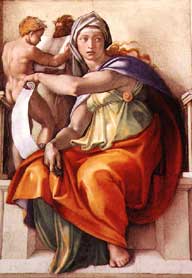
Women were at varying times in history revered as equal in station to men within the church. A simple and undeniable example of how women were once acknowledged as equals to men may be seen when we look at the ceiling of the Sistine Chapel in Rome, where for all the world to see, Michelangelo painted five women — Sibyls — in equal station with the Prophets of the Old Testament.
The painter's greatest work includes on the ceiling, five prophets of the Old Testament, each paired with a Sibyl on the opposite wall. These include the Delphic Sibyl and Joel, Isaiah, and the Erythraean Sibyl, the Cumaean Sibyl and Ezekiel, Daniel and the Persian Sibyl, and the Libyan Sibyl and Jeremiah. The theme of the artist's message suggests the idea of "Redemption and suggests that Revelation in both the Judaic world and in the 'Pagan World' shared the same theme.
During the Renaissance the rediscovery and study of many of the Ancient Greek and Roman writings, previously lost to the West when the Roman Empire was destroyed by barbarians, stirred acknowledgment of the role of women in the historical development of religion and philosophy. While in later times, the knowledge of women's role in history intellectually was squelched by the orthodox teachings, knowledge of the role of women was preserved in this great work. (Web Gallery of Art)
Who were these Sibyls and why did the Church of Rome allow Michelangelo to incorporate these women into his masterpiece of religious history with such prominence? To answer this question, we must look the influence of women in the pre-historical period and during the days of the Greco-Roman Empire when women were looked to for both wisdom and guidance, when women as guardians of the Way and Truth were held in high esteem.
In the period prior to the development of cities, during the development of the agricultural societies, women were the mainstay of the communities. They farmed the land and cared for the children while men were away hunting. Later, women influenced the development of the city-state and religion. They alone tended the fires of the hearth and managed affairs at home while men went off to war. They were the teachers of the young and as the the first farmers, developed the agricultural knowledge of farming and investigated and developed the use of herbal medicines and knowledge of healing.
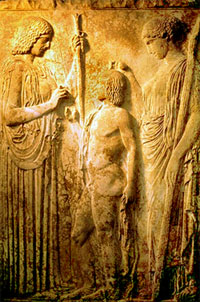 Even later, women impacted religious literature and philosophy. We may look to the myths and legends of the many Ancient Societies for numerous examples. In the Western World of the Greco-Romans, in the earliest period, women were accorded stations of equality with men. Themistoclea, played "a central role in the development of early Pythagorean philosophy... there exists a record that Pythagoras acquired the greater part of his ethical doctrines from Themistoclea, the Priestess of Delphi...."
In addition, the wife of Pythagoras (circa 582 BC–507 BC), was a member (along with her three daughters) of the original Pythagorean cult.
"Ancient sources point to women as active participants, playing a central role in the development of early Pythagorean philosophy. Pythagoras produced a school of philosophy that was religious and mystical and the Pythagoreans made important contributions to mathematics, musical theory, and astronomy. What is not commonly known however is that there exists a record that Pythagoras acquired the greater part of his ethical doctrines from Themistoclea, the Priestess of Delphi, and that what he taught he had heard from her."
"There is a document attributed to Theano in which she discusses metaphysics, and there are records of her many written works in which she expresses her views on marriage, sex, women, and ethics. Upon the death of Pythagoras, Theano, alongside her two sons, became the director of the Pythagorean school.... In his work, Symposium, Plato named Diotima of Mantinea as Socrates’ mentor... Aspasia of Miletus was an influential intellectual, active in the inner circles of ancient political and intellectual life at the time of Plato. She was a leading member of the Periclean circle, and thus, with others, a co-architect of the Sophistic movement... Aesara of Lucania was a late Pythagorean (the late Pythagoreans existed roughly between 425 BC and 100 AD) who applied the normative principle of harmonia. Harmonia is the principle "of all the things that are," including geometry, arithmetic, music, and the cosmos. With ethics grounded in pragmatism, Aesara wrote The Book on Human Nature, which presented an intuitive natural law theory. She argued that by analyzing the nature of the soul we will understand the nature of law and of justice at the individual, familial, and social levels. Aesara showed that harmonia is the principle of law, justice, and human psychology.... ( Women Philosophers of Ancient Times)
Hypatia of Alexandria was one of the cities most renowned Neo-Platonic philosophers and also a mathematician. By the age 30, she was known in distant intellectual communities such as Libya and Turkey. During a period of religious persecution against the Jews and Pagans by the Christians, the government honored Hypatia with a paid, public position "as the head of the Neo-Platonic school of Plotinus.... She taught geometry, mathematics, the works of Plato, Aristotle, Neo-Platonism, astronomy, and mechanics." She met an "early and gruesome death at the hands of a mob of monks who pulled her from her chariot, drug her into a church, stripped her of her clothing, hacked her body to pieces with sharp shells, then took her dismembered body to another location and burned it.... her teachings and writings were virtually ignored by historians of philosophy for almost 1500 years." (Women Philosophers of Ancient Times)
"Asclepigenia of Athens, a younger contemporary of Hypatia. Asclepigenia taught in the Neo-Platonic school in Athens, headed by her father. Her ambition was to understand and master "the 'secret' principles of metaphysics which controlled the universe." Her knowledge of Plato and Aristotle contributed to answering the metaphysical questions raised by Christian ethical theory. At the passing of her father, she, with her brother and a colleague, directed of the Academy. Her most famous student was the philosopher, Proclus, who wrote numerous commentaries, one of which tells us a little bit about the Pythagoreans." (Women Philosophers of Ancient Times)
"The Pythagoreans considered all mathematical science to be divided into four parts: one half they marked off as concerned with quantity, the other half with magnitude; and each of these they posited as twofold. A quantity can be considered in regard to its character by itself or in relation to another quantity, magnitudes as either stationary or in motion. Arithmetic, then, studies quantity as such, music the relations between quantities, geometry magnitude at rest, spherics magnitude inherently moving."
(See: Proclus: A Commentary on the First Book of Euclid's Elements
Another notable woman of the Ancient World was Arete of Cyrene. She was the daughter of Aristipuss, a student and friend of Socrates, who was also present at Socrates’ death. Aristipuss founded and headed the Cyrenaic school in Cyrene, which is now northeastern Libya. The school was one of the earliest proponents of hedonism, and after his death Arete succeeded him as the head of the school. She taught natural and moral philosophy for 30 years, wrote 40 books, and counted among her pupils 110 philosophers. She was held in such high regard that upon her death her countrymen inscribed on her tomb an epitaph that declared she was the splendor of Greece and possessed the beauty of Helen, the virtue of Thirma, the pen of Aristippus, the soul of Socrates, and the tongue of Homer. (Women Philosophers of Ancient Times)
Christian Women included such as Makrina,
In the 4th century AD a girl by the name of Makrina, living in a Roman province, survived, along with her family, persecution by the Christians by hiding themselves in the wilderness for 7 years. Makrina’s paternal grandmother, Makrina the Older, had been famous as a pupil of Christian religion and Greek philosophy. Makrina lived an ascetic life on the family estate with her mother, former slave women, and other aristocratic lady-companions. She had a sharp mind for philosophical thinking, was well educated in Greek philosophy, and she occupied herself with philosophy most of her life. Her brother Gregory, who admired her greatly, wrote of a philosophical discussion he had with her at her death bed on the topic of the soul and the resurrection. (for more see: Women Philosophers of Ancient Times)
And Thecla,
The reputed pupil of the Apostle Paul, who is the heroine of the apocryphal "Acta Pauli et Theclae" (cf. APOCRYPHA). Our knowledge of her is derived exclusively from these Acts, which appeared about 180. According to this narrative Thecla was a virgin of Iconium who was converted to Christianity and led to dedicate herself to perpetual virginity by the preaching of the Apostle Paul. Miraculously saved from death at the stake to which she had been condemned, she went with St. Paul to Antioch in Pisidia where she was thrown to the wild beasts and was again saved from death by a miracle. After this she went to Myra where the Apostle was, and finally to Seleucia where she died. With the consent of St. Paul she had acted as a "female Apostle" in proclaiming the Gospel.
 During the time of Christ, we may look to women for examples, especially in regard to Mary Magdalene who is sometimes called the Apostle to the Apostles because she is reported to have been the first to see Jesus Christ after the Resurrection. Other ancient views of Mary Magdalene as a teacher and companion of Christ are beginning to be more accepted today, although they remain unproven. These are made known to us primarily due to the Nag Hammadi Library. The Gospel of Philip states: "the companion of the [Savior is] Mary Magdalene.... There were three who always walked with the Lord: Mary his mother and her sister and Magdalene, the one who was called his companion. His sister and his mother and his companion were each a Mary (NHC II.3.59.6-11) (Robinson 1988: 145). The Gospel of Philip continues:
[But Christ loved] her more than [all] the disciples [and used to] kiss her [often] on her [mouth]. The rest of [the disciples were offended] by it [and expressed disapproval]. They said to him, "Why do you love her more than all of us?" The Savior answered and said to them, "Why do I not love you like her? When a blind man and one who sees are both together in darkness, they are no different from one another. When the light comes, then he who sees will see the light, and he who is blind will remain in darkness" (NHC II.3.63.32ff) (Robinson 1977: 138)... See Mary Magdalene: Author of the Fourth Gospel?
 Women of the ancient world were instrumental in the development of both philosophy and the church. In the agricultural societies, an idea of God developed. God was seen as transcendent figure in female form and reflected the role of women as creators. Women in agricultural societies represented the mysteriousness of life in a threefold form: Virgin, Mother, and Ancient One or Maiden, Mother and Crone.
The three aspects of the goddess are The Maiden [or Virgin] (Greek Persephone), pure and a representation of new beginnings; The Mother (Greek Demeter), wellspring of life, giving and compassionate; and The Crone (Greek Hecate) wise, knowing, a culmination of a lifetime of experience. These aspects may also represent the cycle of birth, life and death (and rebirth). More than anything, though, Neopagans believe that this goddess is the personification of all women everywhere. Many Neopagans claim historical antecedent for their beliefs, with some even holding that in Old Europe, in the Aegean world, and in the most ancient Near East, the Triple Goddess preceded the coming of nomadic speakers of Indo-European languages. In South Arabia the moon-god Hubal was accompanied by the three goddesses, Uzza the youngest, al-Lat ("the Goddess") and Manat the crone, the three crones.
Wiccans often work with the Goddess in her triple form but may sometimes look at a particular goddess as Maiden, Mother and Crone even when there is no historical proof of this. An example of this would be the goddess Hecate, who was originally depicted as three maidens when in triplicate or as an old woman by herself in later times. Another example is the goddess Morrigan... The Maiden represents enchantment, inception, expansion, the female principle, the promise of new beginnings, youth, excitement, and a carefree erotic aura. Maiden goddesses include: Brigid, Nimue, Skuld, Durga and others.... The Mother represents ripeness, fertility, fulfillment, stability, and power. Mother goddesses include: Aa, Ambika, Ceres, Astarte, Lakshmi, Verdandi and others... The Crone represents wisdom, repose, and compassion. Crone goddesses include: Hel, Maman Brigitte, Oya, Sedna, Urd, Kali, and others.

(For more see: http://en.wikipedia.org/wiki/Triple_Goddess
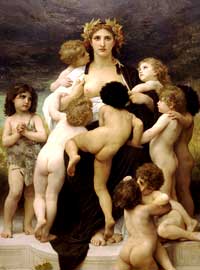 As Virgin, the development of women's bodies and their ability to bear and nurture children was perceived of as a magical event. The menstrual cycle of 28 days correlated with the 28 day cycle of the moon; thus the moon became a powerful symbol for women. The moon, most always associated with night and the mysteriousness of darkness and sleep enhanced the mystery of women, for superstitious early man equated sleep with death and death with darkness.
Women's ability to bleed and stop bleeding was a great source of wonder to men, who when wounded seriously, died from loss of blood. As Mothers, the women mysteriously bore children, bled monthly and survived, apparently by magic, and women independently provided the main sustenance for children through their milk. Women were also the ones who tilled the soil, prepared the food, made the clothing, built the homes, bore the children, and raised the children. Women, in pre-historic days, were the teachers: they taught children what they needed to know to survive as adults and were the mainstay of the agricultural community. From the viewpoint of men, women were autonomous creators and providers; women could survive without men.
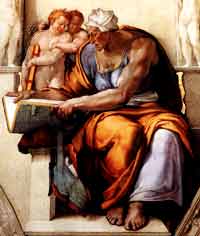 As Ancient Ones women were the storehouses of knowledge for the survival of the culture and the family or tribal unit. In those days, living to old age and surviving the child bearing years and the hardships of everyday life was a miracle in itself; such women were accorded occult power over life and death. With a storehouse of life experience and knowledge women were sources of wisdom. They passed on their teachings and their wisdom in the oral tradition to other women. This knowledge lay outside the domain of men in general.
Women also preserved clan and family lineages. In ancient days descent was determined through the matriarchal line and the brother and sister relationship was dominant over the relationship of husband and wife, for brother and sister were children of the same mother and their lines could be traced. In the ancient matriarchal society women also defined the laws of behavior and inheritance because women defined the lineage. Women were also the lawmakers and judges. Matriarchs controlled inheritance and the distribution of goods and exchange.
As agricultural communities made the transition to an urban lifestyle they carried the concepts of their ancient traditional structure with them. At first these concepts manifested themselves in the sophisticated idea of the female goddess throughout the Mediterranean Civilizations including Egypt. Egyptian, Grecian, Babylonian, and Roman history abounds with examples of the female goddess in such forms as Isis, Ishtar, Venus and Aphrodite. 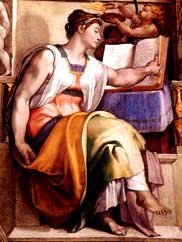 Their attributes encompassed themes compatible with the ideas of fertility and autonomy, birth, death, and regeneration. Nurturing qualities included gentleness, wisdom and love, but there were also goddesses of War. The power of the destructive forces of nature was also acknowledged.
As people sought wisdom and guidance from the Ancient Ones, women became more and more powerful and priestesshoods evolved. As civilizations developed, the populace looked to the Ancient Ones for divine guidance. Because of their old age these women were considered as semi-divine and having special relationships with the gods and goddesses. Over time it became a specific duty for one in particular to have the sacred chore of being what was called a Sibyl, meaning oracle or prophetess. The Sibyl's duty was to sit in a sacred shrine and prophesy for those who sought answers to specific questions. According to the records, the most prominent of the Sibyls for the most part were well advanced in age.
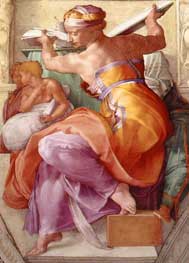 Sibyls were well established figures in the Greek city-states by the 4th and 5th B.C. Hericlitus, a philosopher of 500 B.C., said the office of Sibyl was older than Orpheus, meaning that the Sibyls were traditional priestesses whose roots stretched so far back in time that their origins were untraceable. Other Ancients also speak well of them. Sibyls are mentioned in the Books of Plato with great respect where they are referred to as sources of reputable wisdom; Sophocles reported that the Sibyls were divinely inspired. Sibyls are also mentioned in many other writings of various cultures including those of Egypt, Italy, Asia Minor, Persia, Erythea and Africa.
Although it is not well-known, written records still exist of the Sibylline Oracles. As these Oracles spoke, scribes recorded what they said in the literary form of the day known as Greek hexameter verse. Greek hexameter verse is a form of rhythmic poetry with accents on particular syllables. In fact, the Bible is written after this same form, in emulation of the Sibylline writings. Few of the earliest writings of 500-300 B.C. exist intact and it is a fact that those that exist have been altered from the original text; however, we can be assured that the altered content must have been consistent with the expectations and reflected beliefs of the day.
The surviving Sibylline Oracles are not the famous Sibylline Books of Roman history, which were lost not once, but twice, and thus there is very little knowledge of the actual contents. The collection of pseudo- Sibylline Oracles in twelve books, written in Greek hexameters, which have survived, contain a medley of pretended prophecies by various authors and of very various dates, from the middle of the second century B.C. at the earliest, to the fifth century A.D. They were composed partly by Alexandrian Jews and revised and enriched by Christian editors, who added similar texts, all in the interests of their respective religions; and in part they refer to events of the later Roman Empire, often portraying Rome in a decidedly negative light.
The sibyls and the so-called Sibylline oracles were often referred to by the early Church fathers: Athenagoras; Theophilus, Bishop of Antioch in the later 2nd century; Clement of Alexandria, Lactantius, Augustine, all knew various versions of the pseudo-Sibylline collections, quoted them or referred to them in paraphrase, and were unreluctant to Christianize them, by as simple means as inserting "Son of God" into a passage, as Lactantius:
"The Erythraean Sibyl" in the beginning of her song, which she commenced by the help of the Most High God, proclaims the Son of God as leader and commander of all in these verses:
All-nourishing Creator, who in all
Sweet breath implanted, and made God the guide of all."
Some fragmentary verses that have been left out of the collections that survive, are only known because they were quoted by a Church Father. Justin Martyr, if he is truly the author of the Hortatory Address to the Greeks, gives such a circumstantial account of the Cumaean sibyl that the Address is quoted here at the Cumaean sibyl's entry. The Catholic Encyclopedia states, "Through the decline and disappearance of paganism, however, interest in them gradually diminished and they ceased to be widely read or circulated, though they were known and used during the Middle Ages in both the East and the West." A student may find echoes of their imagery and style in much early medieval literature, nevertheless. (See: Sibylline Oracles)
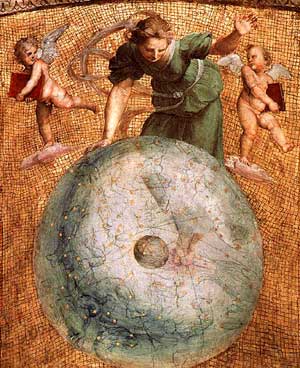 |
Pseudepigrapha: Beginning from the first generation |
||
We can see by the small amount of material presented here that the women of the pre-historic period and the later Sibyls were very important to the evolution of the Jewish and Christian religions. The most influential list of Sibyls consisted of ten. During the Middle Ages, the Church increased their number to twelve to correspond to the twelve apostles.
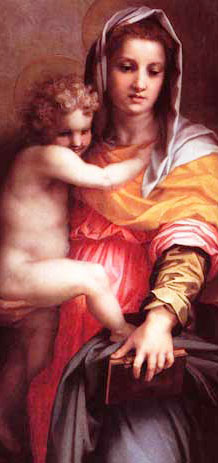 Mary eventually replaced the Sibylline Oracles, but her status in the Church may be largely ascribed in the Western Tradition to the reverence with which the Sibyls of the Ancient World were once held. Mary was included in the early church at the demand of the masses, for they required a female goddess and it seems would not accept Christianity without one. Books about Mary and other women in the church may be found in the Apocryphal Gospels. Her role as the revered Mother of Jesus Christ in the present day has been underplayed to the role of Virgin only, however, in the more ancient period, Mary must have certainly enjoyed the role of the three faces of Woman: Virgin, Mother and Wise Woman.
We have seen but a brief glimpse through the above that women have had a direct and indirect impact on history and biblical literature and thus the religion we practice today. We have seen how women, especially the Sibylline Oracles were perceived as mysterious and transcendent voices of the gods and of the Judaeo-Christian God. In the ancient world, women were held and raised up to positions of esteem and power. As voices of reason they influenced religious thought, morality, political history and Biblical literature and in the Ancient World, women became priestesses in their own right.
It seems that it was only in the last days of their service, when they preached against the expansion and excesses of the Roman Empire, that the Oracles lost their position as High Priestesses of the One God. Coincidentally, it is ironic to note, that both the monotheism of Judaism and the prophesy of a coming of a Savior were promulgated and advanced to a greater degree due to the Sibylline Oracles and their female ancestors.
The ideas that they put forth promoted Judaism, Christianity and in general Monotheism throughout the Western World. Surely the question of "should" women be ordained will be resolved as the general public becomes more aware of the real role of women and the impact of women in the development of the church and history in general.